


Every time you wade into a cult‑like debate, the tit‑for‑tat circus kicks off. No need to drag in “contradictory science”—the Climate Change Calamitous Claims (or FourCees, as the jokers call them) collapse just fine under their own data. A focused, logical look is enough, and for entertainment value, it’s basically “tip for tap”—a phrase that’s been bouncing around since the 16th century, proving that even arguments age like fine wine.
On a recent trip through the Angeles National Forest, I couldn’t help noticing the mountains looked greener than they did four years ago. For a moment I wondered if I was hallucinating, but old photos backed me up. Of course, in the spirit of full disclosure, it’s winter now and those earlier shots were taken in summer—so maybe the only thing changing is my seasonal sense of irony.
Then the eccentric thought landed: what if higher CO₂ emissions are actually saving the planet? After all, plants treat the “nasty gas” like a five‑star buffet. Could it be that the scientific chorus is wrong? Wouldn’t be the first time. Most of them just echo the same data and opinions from a select few, squawking like trained cockatoos in lab coats.
Science, of course, is famous for eating its own tail. Entire fields churn out studies that later get debunked or contradicted. Take coffee: one day it’s the miracle elixir of life, the next it’s downgraded to witch’s brew. Experts, we’re told, are never wrong—except for the countless times they are.
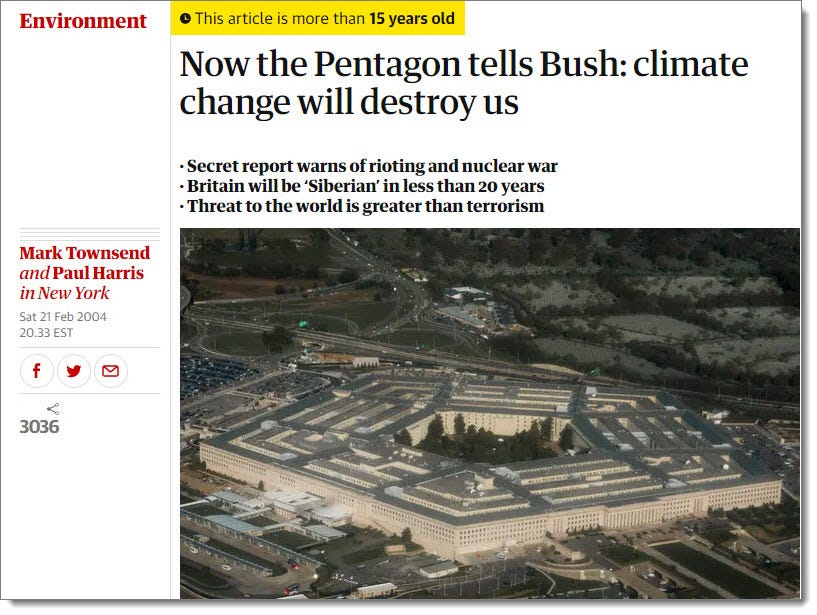
Which brings us back to the myth of unquestionable expertise. This tune has been played on repeat for decades. If you’re curious, The Guardian published a piece more than 15 years ago highlighting the “experts” behind a Climate Change report. Read it at your leisure, but don’t be surprised if the chorus sounds suspiciously familiar.
A secret report, suppressed by US defence chiefs and obtained by The Observer, warns that major European cities will be sunk beneath rising seas as Britain is plunged into a ‘Siberian’ climate by 2020. Nuclear conflict, mega-droughts, famine and widespread rioting will erupt across the world.
Reliable sources are always the backbone here—no click‑bait conspiracy theorists in sight. The so‑called “secret report” wasn’t scribbled by basement bloggers chasing ad revenue, but it did offer a peek into Pentagon logic. Maybe that explains why the U.S. spent 18 years slogging through Afghanistan, a quixotic mission to deliver democracy to a place that wasn’t exactly lining up for it. Meanwhile, Britain hasn’t frozen into Siberia yet, but London’s new nickname—Londonistan—suggests it’s inching closer to the tundra, at least culturally.
But let’s pivot back to actual science. Upstate New York recently revealed the world’s oldest fossil forest, dating back 385 million years. That was the Devonian period, when a sharp drop in CO₂ cooled the planet and may have triggered an extinction. Translation: even prehistoric trees had a front‑row seat to climate drama long before SUVs and jet engines entered the stage.
“That’s sort of the opposite of what we’re experiencing today, with the possibility of an extinction as well,” Stein said.
We’re told extinction is inevitable no matter the CO₂ levels—hence the conveniently vague word “Change.” And Mr. Stein’s favorite safety nets? The ever‑elastic “may” and “possibility,” which let you say everything without actually saying anything. Meanwhile, the average activist just skims the headline, skips the dots, and avoids the logic—because connecting them might lead to uncomfortable truths.
So let’s dig deeper. Enter the Devonian period and the claim: “Evidence of mass extinction associated with climate change 375 million years ago discovered in Central Asia.” That’s the excerpt that actually matters, buried beneath the slogans and scare‑lines.
In the Devonian period, Waters explained, the world was experiencing super greenhouse climate conditions. This means that it was very warm, there probably were no ice caps, there was a lot carbon dioxide in the atmosphere (with estimates of 4,000 parts per million).
“As plant communities expanded onto land to form the first forests, they depleted the carbon dioxide (CO2) that was in the atmosphere,” Waters said. “CO2 levels dropped to 400 ppm toward the end of the Devonian. It got colder. There were glaciation events and the rapid change in the climate caused severe extinction in the tropics and the existing coral reefs became extinct.” By comparison, the world’s current CO2 level is very close to 400 ppm.
Forget “greenhouse”—back then it was super greenhouse. Forests thrived with CO₂ levels ten times today’s 400 ppm, a state scientists now politely call “depletion.” Fast‑forward to the present, and here we are, sailing oceans like wannabe Vikings, chanting cutesy eco‑mottos, dodging fossil fuels, and warning of Armageddon while pretending we’ve mastered the riddle branded as Climate Change. Naturally, scientists always have a tidy explanation ready to herd the faithful back into the fold, while brushing off the obvious, irritating questions as—well, too obvious.
And so, borrowing from my earlier and extremely beautiful and clever post “Climate Change, CO₂ And You,” let’s revisit the mid‑Pliocene period, when conditions looked suspiciously familiar to today’s climate drama.
The Arctic was literally smoking, and getting to the beach was a lot faster. Funky volcanoes aside, why were CO₂ levels and temperatures during the mid-Pliocene period equivalent to current readings? Here’s the verifiable truth: Population on Earth was extremely smaller 3 million years ago, Chevys, Volkswagens and Rolls-Royce jet engines were not around, fossil fuels were undisturbed, and wood burning was all the rage. Could a reading of 500 ppm of CO₂ in the atmosphere provide an unparalleled bounty of forest green?
The burning question: what on Earth cranked CO₂ up to 4,000 ppm during the Devonian period? And while we’re at it, would a cozy 1,000 ppm today turn deserts into lush jungles, sink the beachfront mansions of the elite, and hand ocean views to the less fortunate? Sounds like socio‑economic equality via rising tides. Meanwhile, someone still has to feed 10 billion people, and let’s be honest—urban organic farming looks great in a brochure next to a unicorn, but it won’t exactly keep the world nourished.
After stepping back and surveying Climate Change logic, data, and science from the big‑picture perch, one conclusion is hard to miss: there’s a whole lot of clueless Chicken Little squawking out there.
