


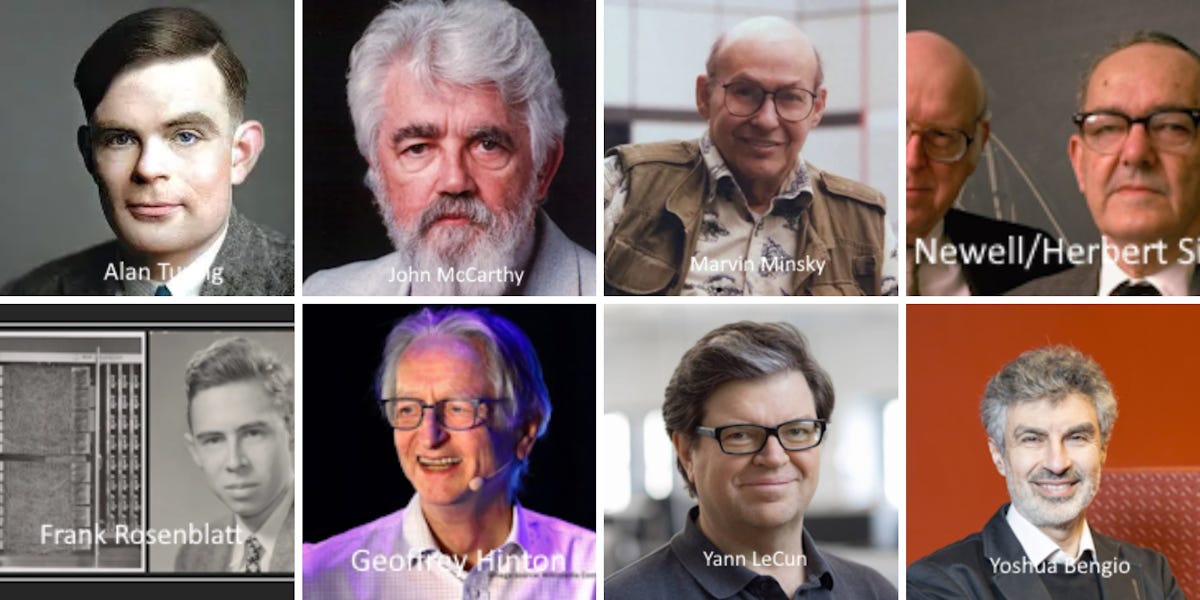
The individuals in the images are widely regarded as foundational figures—often called the “fathers” or pioneers—of artificial intelligence (AI). They span from the theoretical origins in the mid-20th century to the modern deep learning era that powers today’s AI systems.
Here is a concise synopsis of each:
Alan Turing (1912–1954): British mathematician and computer scientist considered the foundational thinker of AI and modern computing. In his 1950 paper “Computing Machinery and Intelligence,” he proposed the Turing Test (originally called the imitation game) to assess whether a machine could exhibit intelligent behavior indistinguishable from a human. His earlier work on the universal Turing machine laid the theoretical basis for all programmable computers. He is often seen as the intellectual father of AI.
John McCarthy (1927–2011): American computer scientist who is frequently called the “father of AI.” He coined the term “artificial intelligence” in 1955 and organized the seminal 1956 Dartmouth Conference, which is considered the birthplace of AI as a field. He invented the Lisp programming language (crucial for early AI research) and pioneered concepts like time-sharing and garbage collection.
Marvin Minsky (1927–2016): American cognitive scientist and mathematician, co-founder (with McCarthy) of the MIT AI Laboratory in 1959—one of the most influential AI research hubs. A pioneer in symbolic AI, robotics, and cognitive modeling, he developed early neural network simulators (like SNARC), mechanical hands, and the “Society of Mind” theory (viewing intelligence as interactions among simpler processes). He co-won the Turing Award in 1969.
Allen Newell (1927–1992) and Herbert A. Simon (1916–2001): Often mentioned together for their collaborative work. American researchers who created the Logic Theorist (1955–1956), widely regarded as the first true AI program—it proved mathematical theorems automatically. They later developed the General Problem Solver (GPS) and advanced symbolic AI through heuristic search and problem-solving models. Their physical symbol system hypothesis argued that intelligence arises from manipulating symbols. Simon also won the Nobel Prize in Economics (1978) for related decision-making work; both received the Turing Award (1975).
Frank Rosenblatt (1928–1971): American psychologist who developed the perceptron (1957–1960), the first implemented artificial neural network capable of learning through trial and error. Built as hardware (Mark I Perceptron), it demonstrated pattern recognition and learning—laying foundational ideas for modern neural networks and connectionism, though early limitations were highlighted in critiques like Minsky & Papert’s 1969 book.
Geoffrey Hinton (born 1947): British-Canadian computer scientist often called the “Godfather of Deep Learning” (or one of the “Godfathers of AI”). His work in the 1980s–2000s revived neural networks through breakthroughs in backpropagation, Boltzmann machines, and deep belief networks. He mentored many in the field and has warned about AI risks. He shared the 2018 Turing Award.
Yann LeCun (born 1960): French-American computer scientist, another “Godfather of AI.” He pioneered convolutional neural networks (CNNs) in the late 1980s–1990s (e.g., LeNet for handwriting recognition), revolutionizing computer vision. Longtime head of AI at Meta (Facebook), he advocates for open-source AI and energy-efficient models. He shared the 2018 Turing Award.
Yoshua Bengio (born 1964): Canadian computer scientist, the third “Godfather of AI.” A leader in deep learning, he advanced neural network architectures, representation learning, generative models, and sequence modeling. He has been a strong voice on AI safety and ethics. He shared the 2018 Turing Award with Hinton and LeCun.
These pioneers collectively built the conceptual, theoretical, and practical foundations of AI—from symbolic reasoning and early neural models to the deep learning revolution that dominates today. The earlier figures (Turing through Rosenblatt) established the dream and first proofs of concept, while the latter trio (Hinton, LeCun, Bengio) enabled the explosive progress since the 2010s.
Now pay close attention to the faces and tell us what you see. So much for “diversity is our strength”, huh? You’re welcome.
