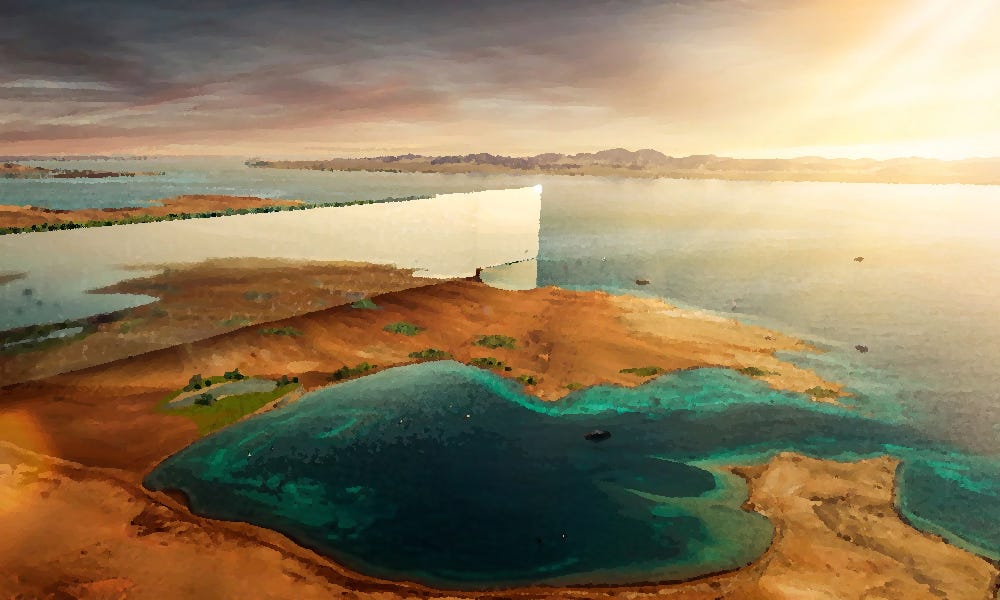
Saudi Arabia’s Neom was supposed to be the ultimate flex: a linear city stretching across the desert, powered by renewable energy, free of cars, and packed with flying taxis, artificial intelligence, and enough glass and steel to make every architect’s ego swell. Crown Prince Mohammed bin Salman’s vision promised a sci-fi metropolis that would redefine urban living and put the kingdom on the map as a 21st-century powerhouse. Instead, after more than $50 billion poured into the sand, the project has slammed into financial reality harder than a sandstorm hitting a half-built skyscraper.
Internal documents and satellite images now reveal the grim punchline. Contracts are being canceled left and right. Billions more are being spent just to walk away from deals. What remains are mammoth concrete skeletons and incomplete structures baking under the desert sun, collecting dunes instead of residents. The world’s largest construction project didn’t fail spectacularly in a blaze of glory. It simply ran out of money and common sense at the same time.
There’s a special kind of comedy in watching these grand political fantasies collide with basic arithmetic. Politicians and their chosen visionaries love announcing megaprojects that sound like they were brainstormed after too much caffeine and zero spreadsheets. Neom was sold as the future. Reality delivered a very expensive ghost town in progress. At least it stopped before completion. China’s empty showpieces—Kangbashi, Yujiapu, Meixi Lake—already proved that shiny new buildings do not magically attract people. Neom simply joined the club with more flair and a higher price tag.
The desert is patient. It will patiently bury the unfinished ambitions under more sand while the accountants finish the cleanup. In the end, Neom offers a clear lesson wrapped in sarcasm: when you try to build utopia on a budget that defies gravity, gravity wins. The only thing rising now is the cost of shutting it all down.