


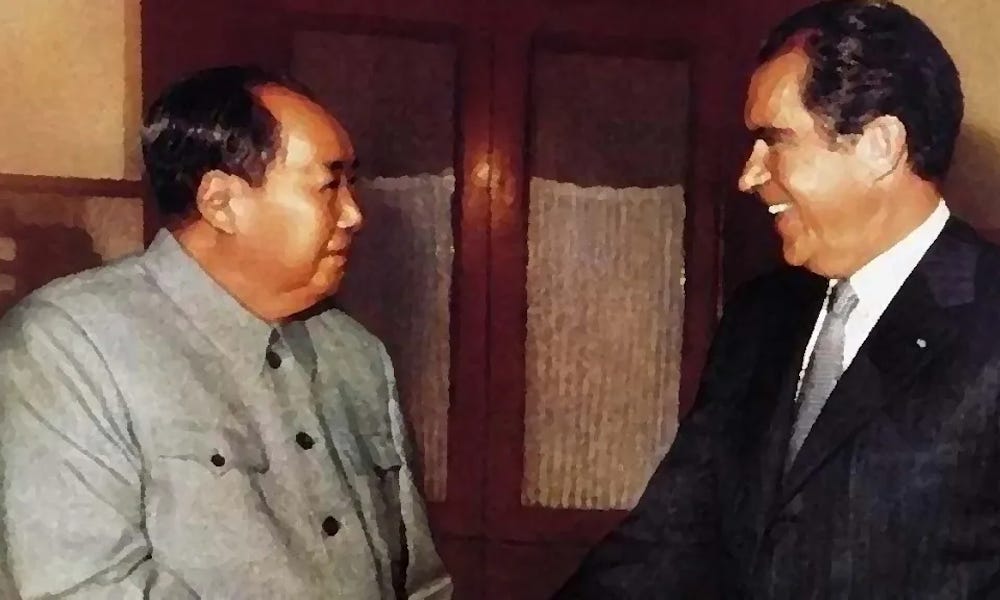
So, picture it: 1949. China dives headfirst into Communism, that shiny sibling of Socialism and the extreme-left dream factory. It promises endless welfare, equality, and rainbows for all—until, of course, human behavior shows up like the drunk uncle at Thanksgiving and ruins the party. But hey, it sounds fantastic on paper!
With World War II reshuffling the geopolitical deck, Americans suddenly worried that Soviet and Chinese influence might spread faster than bad fashion trends. Cue the old saying: keep your friends close and your enemies closer—preferably close enough to spy on their dinner menu. Enter Richard Nixon in 1972, strutting into China with the official excuse of “better relations.” Sure, that was the press release, but let’s be honest: there was probably more going on behind the curtain than a diplomatic tea party.
And of course, when the present looks like a long-running flop dressed up in a mask, people love to wax poetic about the ancestors. Nothing like glorifying the past when the present feels like a rerun of bad decisions. According to china.org.cn…
China is an East Asian country with a large territory, a huge population and an ancient history. With written records dating back 4,000 years, it is recognized as one of the four great ancient civilizations of the world, together with ancient Egypt, Babylon and India. Moreover, it is the only ancient civilization that has continued to this very day.
Read through that website and you’d swear China was the gravitational center of the Universe, with intellectual firepower so overwhelming the rest of us should just surrender our passports. But then comes the awkward question: how do we explain the lack of major achievements as recently as three decades ago? History, after all, is often less about truth and more about self-promotion—especially when the present doesn’t offer much to brag about. In fact, history is frequently just artistic license dressed up as fact, and humanity’s favorite pastime is proving we learn nothing from it by repeating the same mistakes on loop.
Spike Milligan once quipped that “chopsticks are one of the reasons the Chinese never invented custard.” Brutal, yes, but the point lands: thinking outside the box isn’t always the strong suit. Case in point: I once chatted with an actual rocket scientist—no metaphor, a real one—and asked him to list China’s great accomplishments across thousands of years, pre–Western outsourcing. His answer? “A pile of rocks they call a Great Wall.” Not exactly a résumé that screams “world domination.”
Yet here we are, with a growing chorus over the past decade insisting China will take over the world. Most people simply parrot what they hear, because critical thinking has been replaced by the dopamine hit of “likes.” And trying to convince the believers otherwise? Utterly pointless. Better to sit back, grab some popcorn, and watch the gurus scramble for cover as their grand theories collapse in real time.
Fast-forward twenty years from Nixon’s handshake tour, and by 1992 the “Great Western Outsourcing” had officially kicked off—otherwise known in clever circles as the irresistible “Trojan Economic Horse.” Bill Clinton didn’t see it coming, but to be fair, he was… let’s say distracted by other extracurricular activities. Meanwhile, cheap labor has always been catnip for short-sighted, quarterly-obsessed capitalists, and we’ll circle back later to explain how capitalism managed to shoot itself in both feet and is now limping toward a very expensive reckoning.
Of course, those labor savings didn’t exactly trickle down to the consumer. Instead, they created their own mess while padding the pockets of a few circus performers at the expense of the starstruck masses. Exhibit A: Nike—where outsourcing became less about sneakers and more about economic acrobatics.
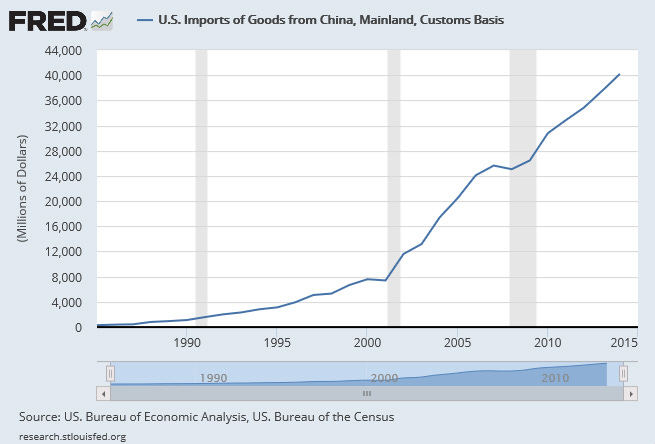
Need proof of this “Great Western Outsourcing”? Just peek at U.S. imports from China, courtesy of FRED. Over two decades, the value of imports skyrocketed by a jaw-dropping 2,000%. Yet somehow, people still gush about China’s rise as if it were purely organic brilliance. Sure, let them believe whatever bedtime story helps them sleep. The painful reality is that when the curtain finally drops, the poor schmucks will be left standing in the spotlight with nowhere to hide.
Jump ahead another 20 years and we land in 2012, where China’s economic boom managed to gift itself two shiny, self-defeating problems. First, domestic political instability—nicely camouflaged by government fairy tales about endless growth. Second, a health crisis so entrenched that importing Canadian mountain air won’t fix it, no matter how many bottles they ship. And let’s not forget the one-child policy, which, unbeknownst to both Chinese and Western scientists, shaved points off the country’s collective IQ. That little experiment will take generations to undo. So here we are, 44 years later, knee-deep in the pollution phase, documented by Bloomberg as the inevitable result of greed and the timeless human tradition of not learning from history. Brilliant. Truly brilliant.
Now, fast-forward to 2032. Odds are China will help trim the Earth’s population numbers while painfully downsizing its economic overcapacity. India will be right there too, proudly hosting New Delhi as the world’s smoggiest capital. Sure, it would be more uplifting to talk about peace, curing disease, erasing poverty, and handing out golden-egg geese to every household. But let’s be honest—that’s not how Earth operates. Humanity’s script is pure irony: every pro comes with a con, every con with a pro, and the so-called “developing world” will keep on not developing, because equality isn’t in the planet’s business plan. The master ecosystem has other priorities.
And no, it’s a stretch to imagine Nixon masterminding this whole saga, plotting for China to choke itself out with pollution. But for those who thrive on blaming everyone but themselves, here’s a fresh conspiracy theory to add to the collection. The demise of a great civilization is underway, and shouting, protesting, or disagreeing won’t change a thing. Though, by all means, everyone is welcome to try—it makes for great theater.
