


For all the doom-and-gloom certainty preached by the apocalypse choir, Climate Change has a curious cult vibe that leaves plenty of people skeptical. These days, the media can’t resist slapping the label on everything—wildfires, floods, soggy wine tastings, even donuts that didn’t rise properly. It’s almost endearing, watching them assume the public is as gullible as their fan club. And of course, they love to blur the line between “climate” and “pollution,” as if those two were twins. Spoiler: they’re not. Everyone hates pollution; climate is a different beast.
But fine—let’s play along and assume Climate Change is the Big Bad Wolf. Enter NASA, the oracle of wisdom, whose website is a linguistic rollercoaster. First it was “Global Warming,” then “Climate Change,” and now we’re back to “Global Warming,” except the site still insists on calling it “Global Climate Change.” A marriage of words so awkward it sounds like climate is a local PTA meeting. And who knows when NASA will decide to rebrand the apocalypse with a new slogan.
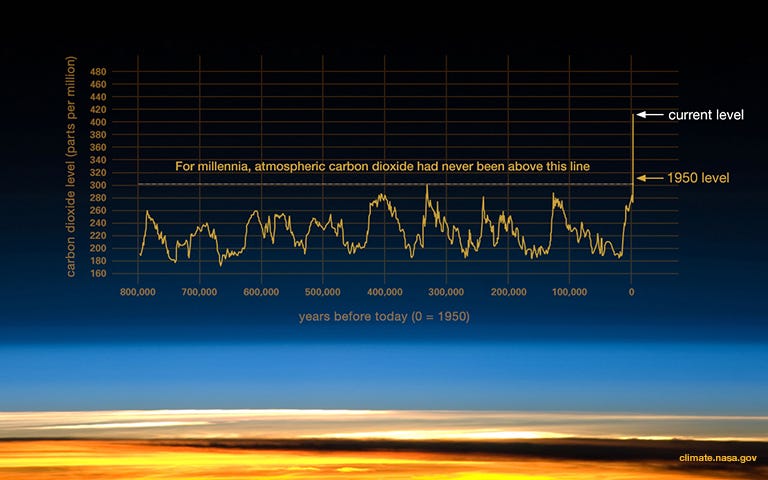
No question about it—the NASA chart titled “The Relentless Rise of Carbon Dioxide” practically screams at you. After 1950, CO₂ shoots up like a sore thumb on steroids. Hard to argue with the evidence, though it never hurts to put the witness under cross-examination. But daring to raise “reasonable doubt” these days? That’s treated like heresy in the politically correct Climate Change cathedral, where skepticism is the one sin that won’t be forgiven.
First things first: where exactly are these atmospheric carbon numbers coming from? Because if global temperature readings are already riddled with gaps and quirks, you’d think someone might raise an eyebrow at the CO₂ data too. Turns out, since 1958, the Mauna Loa Observatory in Hawaii has been the go-to source. Picturesque, yes. Neutral, not so much. And while the peculiarities of the location raise perfectly reasonable doubt, don’t worry—the explanations are always neatly packaged, tied with a bow, and filed under “nothing to see here.”
Mauna Loa is indeed an active volcano; it last erupted in 1950, 1975, and 1984. Between eruptions, it emits variable amounts of carbon dioxide (CO2) and sulfur dioxide (SO2) from fissures at the summit.
Any average juror would probably ask the obvious: couldn’t we find better spots around the globe to measure CO₂? NOAA insists it’s got this covered with weekly flask samples from over 60 remote locations worldwide—a detail that sounds reassuring, yet still feels oddly puzzling. Fine, we’ll take it at face value.
But here’s the kicker: the timing. Data collection conveniently begins at Mauna Loa in 1958, right after the 1950 spike that NASA’s graph loves to spotlight. Enter Charles David Keeling, who launched the monitoring program and gave us the now-iconic “Keeling Curve.” It’s waved around like gospel evidence, but let’s be honest—it lacks historical context. Starting the story in 1958 makes the curve look like a horror movie trailer, leaving the unsuspecting bystander convinced the apocalypse is already halfway through.

What’s missing here is the “why.” Why did atmospheric carbon nearly double, then get chopped in half across the ages, only to finally break the 300 ppm ceiling—set some 350,000 years ago—during what looks suspiciously like a Hawaiian vacation 60 years back? And let’s not forget: Homo sapiens only clocked in about 200,000 years ago. So was the spike the grand sum of the Industrial Revolution, fossil fuel gluttony, and the fireworks of two world wars? Or maybe it was Asia’s late‑90s economic boom finally flexing its carbon muscles?
Cue the Ivy League entrance music. In 2017, the Yale School of Forestry & Environmental Studies published “How the World Passed a Carbon Threshold and Why It Matters.” The opener proudly declared: “Last year marked the first time in several million years that atmospheric concentrations of CO₂ passed 400 parts per million.” Translation: the NASA graph’s scary 1950 jump isn’t just a blip—it’s the headline act in the climate horror show.
The last time the planet had a concentration of 300 to 400 ppm of CO2 in the atmosphere was during the mid-Pliocene, 3 million years ago — recently enough for the planet to be not radically different than it is today. Back then, temperatures were 2 degrees C to 3 degrees C (3.6 to 5.4°F) above pre-industrial temperatures (though more than 10 degrees C hotter in the Arctic), and sea levels were at least 15-25 meters higher. Forest grew in the Canadian north and grasslands abounded worldwide; the Sahara was probably covered in vegetation.
Once upon a time, Earth was greener—literally—which suggests that less CO₂ equals deserts and hunger. Back then, the Arctic was smoking like a chimney, and beach trips were practically a sprint. Volcanoes did their funky thing, but here’s the head-scratcher: why were CO₂ levels and temperatures during the mid‑Pliocene basically the same as today? The undeniable truth is simple: three million years ago, the population was tiny, Chevys and Volkswagens hadn’t rolled off assembly lines, Rolls‑Royce jet engines weren’t roaring, fossil fuels sat untouched, and wood fires were the hot new tech. So maybe 500 ppm of CO₂ was less apocalypse and more forest buffet. Climate Change science, in this light, feels inconclusive at best and self‑defeating at worst.
Give any claim enough time and an unbiased mind, and it can be dismantled to everyone’s satisfaction—or irritation. Which means it’s on you, dear juror, to deliver a fair verdict without succumbing to the emotional theater.
And before the crowd rushes onto the “clean energy” bandwagon, singing hymns to electricity while demonizing combustion engines, let’s remember: electricity isn’t a saint either. The World Health Organization itself admits that electromagnetic fields above certain levels can trigger biological effects—or defects. Translation: even the shiny new savior comes with fine print.
Based on a recent in-depth review of the scientific literature, the WHO concluded that current evidence does not confirm the existence of any health consequences from exposure to low level electromagnetic fields. However, some gaps in knowledge about biological effects exist and need further research.
Electricity may be old news, but in terms of sheer volume we’re still toddlers playing with the light socket. Fast‑forward 50 years and don’t be surprised if humanity evolves into a circus act—two noses, three eyes, and half a brain, courtesy of our glowing obsession.
