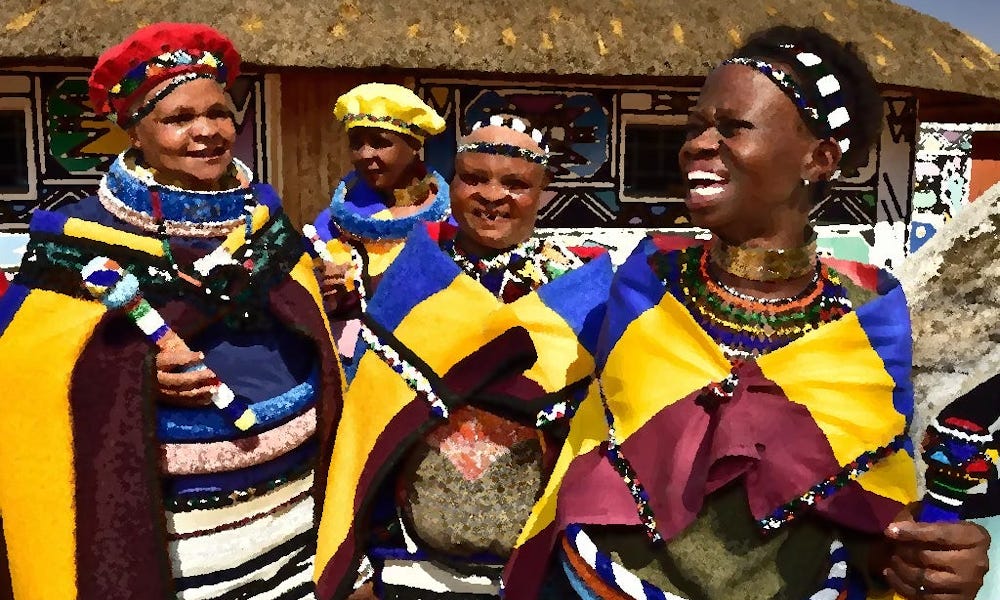
Let’s stipulate for the time being that “race is a social construct” and “diversity is our strength” which is perfect for what follows. Africa has an extraordinary level of diversity — in fact, it is widely regarded as the most diverse continent on Earth across multiple dimensions.
Here’s a breakdown of the key aspects:
Genetic diversity — Africa is the cradle of humanity, where modern humans originated. As a result, it harbors the highest levels of human genetic variation anywhere in the world. The average African genome contains far more variants (nearly a million more) than the average non-African genome, and genetic differences within African populations often exceed those between Africans and people from other continents combined. Studies consistently show Africans have the greatest genetic diversity, with hunter-gatherer groups like the Khoisan and certain Central African rainforest populations ranking among the most genetically diverse human groups alive today.
Linguistic diversity — Africa is the most linguistically diverse continent, home to between roughly 1,250–3,000 languages (depending on how dialects are counted), which represents about one-third of all languages spoken worldwide. Nigeria alone has over 500 languages. These belong to major families like Niger-Congo (including Bantu languages), Afroasiatic, Nilo-Saharan, and Khoisan (famous for click consonants). This is far greater than any other continent — Europe, by comparison, has only around 300 languages.
Ethnic and cultural diversity — There are estimates of over 3,000 distinct ethnic groups across the continent (some sources place it in the several thousands). African countries average far more ethnic groups per nation than elsewhere (often >8 per country, versus 3–5 globally), accounting for roughly 43% of the world’s ethnic groups. This includes everything from nomadic pastoralists (e.g., Maasai, Fulani), hunter-gatherers (e.g., San/Bushmen, Pygmy groups), agricultural societies, urban communities, and more. Cultural practices vary enormously — subsistence strategies, social structures, music, art, religions (indigenous beliefs, Islam, Christianity, and blends), clothing, and traditions differ dramatically even between neighboring groups.
This diversity stems from Africa’s deep human history (longest continuous habitation), varied environments (deserts, rainforests, savannas, mountains, coasts), historical migrations (like the Bantu expansion), and relative barriers to large-scale homogenization in many regions.
In short: yes, the statement is not just correct — it’s an understatement. Africa’s diversity in genetics, languages, ethnic identities, and cultures is unmatched globally.
But picture this: Someone casually drops, “Yeah, Africa—it’s basically one big country, right? Lions, safaris, mud huts, and everyone speaks... African?”
Oh honey, bless your map app. Africa is actually 54 sovereign countries (plus a couple of “it’s complicated” territories), more nations than there are in Europe and North America put together. But sure, let’s pretend it’s all one giant village where everyone shares the same playlist, cuisine, and Wi-Fi password. Because nothing says “diverse continent with unmatched genetic, linguistic, and cultural variety” like lumping Casablanca’s mint tea, Lagos traffic jams, Cape Town’s Table Mountain vibes, and Addis Ababa’s injera scene into “just Africa things.”
It’s like calling Europe “that one place with croissants and beer”—except way more ignorant because Africa has over 3,000 ethnic groups, 2,000+ languages, and landscapes that go from Sahara dunes to Congo rainforests to Kilimanjaro snow in a single continent. But go off, I guess—tell me more about how you “rode a giraffe to school” or whatever the stereotype du jour is..
From a socio-techno-economic perspective, are you sure that “diversity is our strength”? And if one is an African-American, which African exactly? Lastly, here’s a simple question for all the imbecilic, still two-legged humans that will quickly point out that the race of the people in question is “black”: Are you sure that race is a social construct and that racism is based solely on skin color?
Bonus video: Franck Zanu